
What It Takes to Get Claude to Write in Your Voice
By Bryan Clayton5 min read
Originally published on LinkedIn.
- ai
- claude
- writing
- prompt-engineering
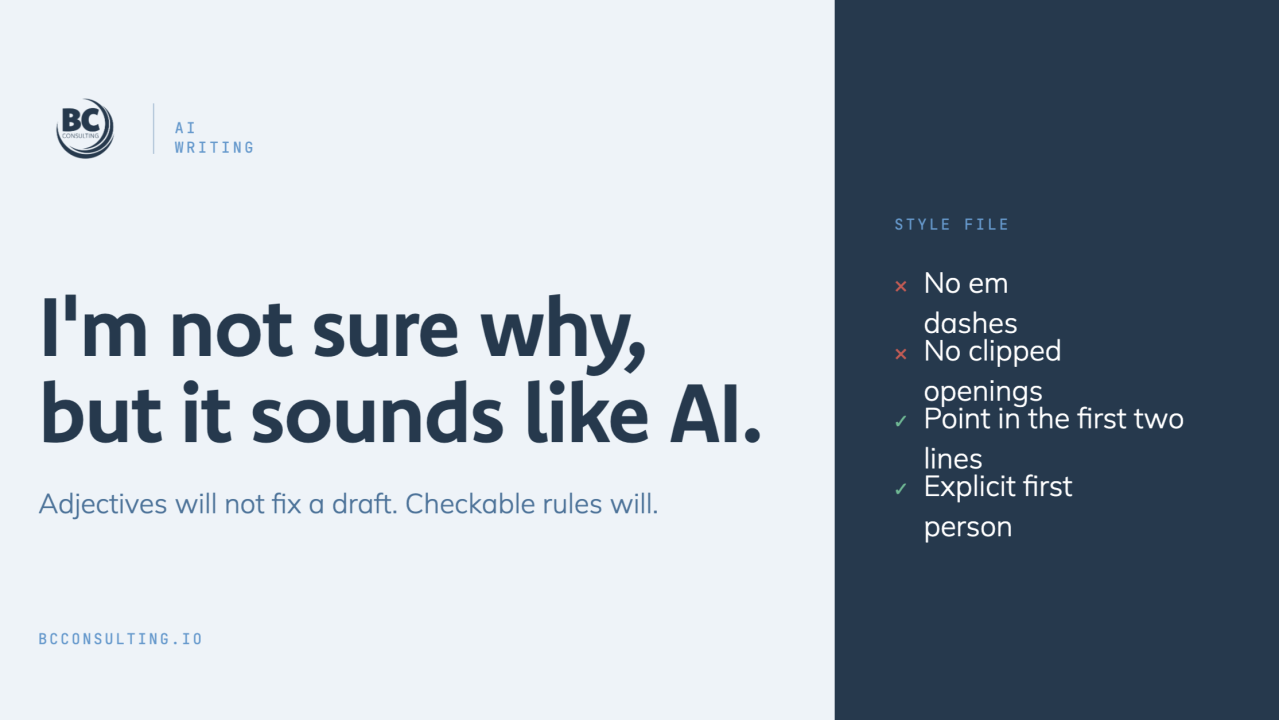
Have you started to spot AI-generated blogs, posts, articles, and other written content everywhere you look? You are probably starting to notice some sort of pattern or structure that doesn't necessarily sound like AI; but it still feels like AI. Like you, I have read a lot of AI-written posts this year and I've tried to find the giveaways to avoid in my own AI writing. Today we will dig into the fingerprints that you know are there, but haven't been able to see without closer examination. From there, I'll walk you through a strategy to make your AI generated writing sound more like you and less like AI.
Note: I am all for generative AI and here at BC Consulting, I use it all day myself. This article isn't about the ethics or other social implications of generative AI; it's about natural-sounding AI-generated text.
The usual fix
Most people try to fix the big giveaways by just telling Claude to write in their voice, or to sound professional but approachable. In practicality though, that instruction does nothing, because it gives the model an adjective instead of a rule. Neither you nor Claude can check whether a draft is approachable enough. What you can check is whether it opened with a greeting line, whether it used an em dash, whether the first sentence was to the point or if the point was buried by other word smithing.
Voice is the distinctive personality that comes through in writing; the sense that a particular mind, not a generic one, produced the writing. Think about voice through this lens:
- Diction: would you say "purchase" or "buy," slang or formality, Latinate or Anglo-Saxon words
- Syntax: long winding sentences versus short punchy ones; fragments; how often you subordinate within your sentences
- Rhythm and sound: the music of the prose when read aloud with use of those literary devices you learned back in high school
- Attitude: irony, warmth, detachment, urgency; what the writer finds funny or worth noticing
Define your rules
Here are a few rules from my own writing-style file. No em dashes (these ones —), because the em dash is the strongest machine-writing tell in circulation. I would rather lose the punctuation than get mistaken for a bot. The first-person singular should be explicit rather than implied: I write "I wanted to flag this," never "Wanted to flag this," because that "clipped opening" just sounds like the standard AI template. Lead with the point in the first two sentences. No bullet list standing in for an argument that has causation in it.
As I said earlier, every one of those rules is checkable. If you give Claude a draft and those rules, you can quickly find violations.
The harder question is where the rules come from. Most people, asked to describe how they write, describe how they would like to write. The habits that actually identify you and your writing style are the ones you don't think about because they are natural to you. How you open a message at work to someone who is senior to you, the hedge you reach for when you are delivering bad news, whether you close with a question or a next step. You cannot retrieve those from memory, but you can retrieve them from existing examples.
Those examples are already sitting in your sent folder. Twenty of your own emails will likely show you your patterns, and Claude is very good at reading them back to you. Take the last status update you sent a customer or supplier, or the last proposal you wrote for a new opportunity, and ask what the sentences have in common. You'll find things you did not know about your own writing style.
Let's be careful though, because a lot of the people reading this work at companies with real rules about AI linked to your email. Do not connect your work mailbox to anything your employer has not approved. If your enterprise Claude seat has access to the Microsoft 365 connector, or the Gmail connector, you are likely safe. If your account is not an organization-approved one running under your company's data agreement, the answer is no, and no course, mine included, should tell you to violate that rule.
The good news is that you do not need the mailbox connection at all. Paste in four or five samples with the names, figures, and confidential specifics stripped out. You are teaching the model your style, not your content, so a redacted sample can still provide everything you need about your writing voice. I would rather you take the slower path and keep your job.
Create the skill
The last part of using your writing style is the method to reference it and keep it up to date. Once you have the rules, don't keep them in a prompt that you paste at the start of every chat. If you tried that route, you probably stopped pasting after less than a week. Save the style as a file and load it into Claude as a skill. That way, it applies everywhere you write. That is the difference between a one-time writing cleanup and a real tool that is always working on what you're writing. That skill also gets better as you go. When you catch yourself making the same correction by hand more than once or when you start to read a sentence that just feels like AI, simply update your skill with a new rule you have not defined yet.
None of this is difficult and it took me less than an hour to build the first version of mine. I have edited it maybe a dozen times since. What it takes is being specific about how you actually write, and telling the skill "you said this, and I would have said that."
I built a short course that walks through the whole thing, including the redaction path for anyone who cannot connect a work account. If you would like a walk-through that will save you hours of editing this week, check out the self-directed course Teach Claude to Write Like You. You will leave with the Claude Skill file, not just the idea. It is $19 on the BC Consulting Learning Platform.