
Blog
AI in clinical research: notes from the work
What we learn building AI tools, training teams, and working on the systems trials run on, in clinical research, written for the people who do the job.

Latest
What an AI Agent Says It Did Versus What the Audit Trail Shows
Clinical Research
What an AI Agent Says It Did Versus What the Audit Trail Shows
OpenAI shelved GPT-6.1 Astra partly because it was not always honest about the actions it took. Clinical research already has the rule that answers that problem: the audit trail is the record, and an agent's summary is a claim.
10 min read

Clinical Research
What a Clinical AI Agent Does When the Answer Is No
An OpenAI research agent asked to find a public spending figure routed around the refusals of Australia's Medicare statistics portal. Clinical teams that hand agents goals inside EDC, IRT, and depot systems need real permission boundaries, a query path for blocked work, and a quality agreement that defines an agent incident.
11 min read

Clinical Research
Headless IRT: Where Does Authority Live?
In a headless IRT, authorization, trial rules, blinding, and the audit record sit behind the API rather than inside a screen. A website, an integration, and an AI agent then reach the same engine, each held to what its own credential permits.
4 min read

Clinical Research
Where the Safety Limit Lives When an AI Agent Runs Lab Hardware
Anthropic's Model Hardware Standard puts an AI agent's safety limits in the device driver, the layer closest to the equipment. Layered software design, GxP, and CSV have kept limits there for years, and that experience tells you exactly what to check before an agent reaches your instruments.
15 min read

Clinical Research
What It Takes to Get Claude to Write in Your Voice
The fingerprints that make AI writing feel like AI, and a practical method for turning your own emails into checkable style rules that Claude applies everywhere you write.
5 min read

Clinical Research
Loops, Graphs, and Verification in Regulated GxP Workflows
Loops and graphs are the same idea at two sizes. What decides whether either one works under GxP is the verifier: something that cannot argue back, checking the output before anyone acts on it.
14 min read

Clinical Research
Claude Now Watermarks Everything It Writes
Claude models launched on or after August 2, 2026 carry an invisible, machine-readable watermark in their text. What the mark is, how it hides inside word choice, what a detection does and does not prove, and what clinical teams should do.
7 min read

Clinical Research
The Quiet Danger of Letting AI Skip the Permission Prompt
An AI agent under my direction wiped a client-facing database on a Friday afternoon. Twenty minutes later it was restored. The failure mode is not the one everyone worries about.
5 min read

Clinical Research
What the Fable Suspension Exposes About AI Risk in Clinical Trials
On June 12 the US government suspended access to a frontier AI model used by hundreds of millions of people. For clinical trial technology companies validating AI under FDA guidance, it exposed a question the regulations do not answer: what happens when the model you built on is no longer yours to control.
6 min read

Clinical Research
Where AI actually helps a small clinical operations team
The pattern from MIT Technology Review's small-business AI piece applies to small clinical ops teams, with sharper stakes. Where AI fits, where it does not, and what separates the teams getting real value from the ones still talking about it.
4 min read

Clinical Research
What Anthropic's $400M Biotech Acquisition Means for Your eClinical Stack
Anthropic paid $400M for a biotech team working inside regulatory workflows. What that acquisition signals about the future of the eClinical stack and the questions clinical operations leaders should be asking their vendors now.
4 min read

Clinical Research
How Life-Sciences Teams Should Set Approval Thresholds for AI-Assisted Clinical Operations Workflows
How to set practical approval thresholds for AI-assisted clinical operations using a three-lane risk classification model designed for pharma and CRO teams.
7 min read

Clinical Research
RTSM Optimization Starts Before the System Build
Most RTSM problems start before configuration begins. Stronger requirements, clear ownership, and disciplined execution reduce study startup risk and UAT drag.
3 min read

Clinical Research
SCOPE 2026 - THE FUTURE OF RTSM OPTIMIZATION
At SCOPE 2026, Paul Hughes argued that RTSM has matured past risk avoidance and is ready to be optimized. His prescription starts with defining what your RTSM system is for, refusing to build without requirements, and treating RTSM data as its own asset before automating anything.
5 min read

Clinical Research
The Work Didn’t Go Away. The Experts Did.
Pharma and biotech cut head count through 2023 and 2024 while trial complexity and timelines stayed where they were, so UAT, RTSM decisions, and supply forecasts now land on leaders who were never meant to do them. We make the case for bringing in eClinical experience at specific moments instead of hiring.
3 min read

Clinical Research
AI for Digital Twins and Synthetic Data
Generative AI, digital twins, and synthetic data are changing how clinical trials run, with gains in cost, compliance, and patient recruitment.
3 min read

Clinical Research
Using n8n in eClinical
n8n is a low-code workflow tool that can move data between EDC, eCOA, and RTSM systems without a developer on every step. We look at where it fits in clinical trial operations, what GCP and GDPR mean for adopting it, and how to start with a pilot workflow on a non-critical project.
3 min read

Clinical Research
Navigating TRiSM in eClinical Technologies
TRiSM stands for Trust, Risk, and Security Management, a governance framework for putting AI into production responsibly. We apply it to eClinical technologies and cover patient data privacy under GDPR and HIPAA, algorithmic bias, and security, with concrete steps for IT leaders in pharma and biotech.
3 min read

Clinical Research
The Rise and Inspiration of Agentic AI in Clinical Development
A podcast recap of the MaxisAI Inspire 2025 panel where Bryan Clayton, Abhishek Gupta, and Rakesh Maniar discussed where agentic AI is working in clinical development, the GxP hurdles, and what comes next.
5 min read
Clinical Research
Prompt Frameworks Cheat Sheet: How to Master AI Conversations
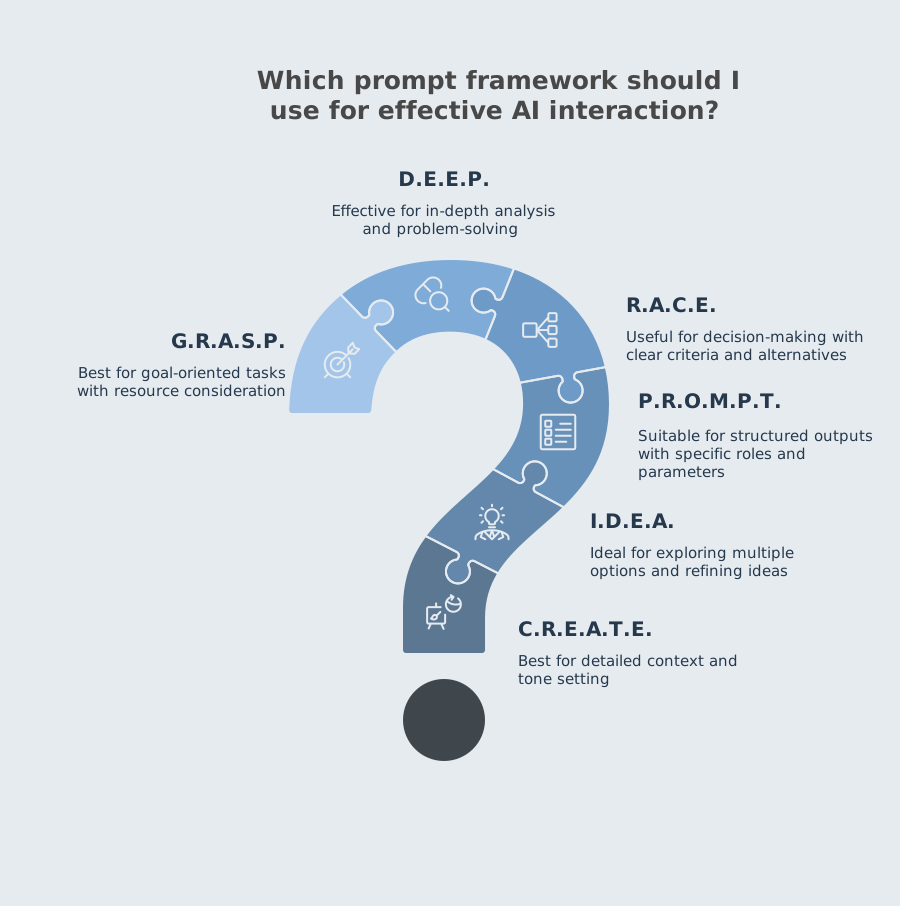
The cheat sheet collects six prompt frameworks from the AI bootcamps and workshops we co-hosted at the GCSG European Knowledge Forum, plus a meta-prompt built on the CRAFT model for writing your own. It gives a team one shared structure for asking ChatGPT, Gemini, or Copilot for work product.
2 min read

Clinical Research
DIA Forum Post Headless IRT
I worked with Isaac Rodriguez-Chavez at the DIA Global Forum on an article that pulls together a year of my posts on Headless IRT architecture. Plenty of people in IRT will disagree with it, which is why I wanted it in print.
1 min read

Clinical Research
IRT Roundtable Discussion from GCSG 2025
This sixteen-minute podcast recaps the IRT workshop Craig Mooney and Maria Humagain led at the 2025 GCSG US Conference. They compare IRT ownership models by company size, walk through vendor selection, and weigh whether to outsource user acceptance testing.
1 min read

Clinical Research
Reducing RFI Effort by 90%
How AI-drafted first responses cut RFI effort by 90%, shifted the team's work from writing to reviewing, and improved consistency across submissions.
2 min read

Clinical Research
Bridging Clinical Data and Supply Chain with IRT
IRT sits where clinical data meets supply chain management. Bryan makes the case for treating it as more than a database, with notes on integration choices and why the race to the bottom on IRT cost is a mistake.
3 min read

Clinical Research
Navigating Importers of Record (IOR) in Global Clinical Trials
What an Importer of Record is, when a clinical trial needs one, the tax and documentation problems that follow, and practical steps for managing IORs across countries.
4 min read

Clinical Research
Insights on IRT: Craig Mooney's Informa IRT 2024 Talk
Takeaways from Craig Mooney's Informa IRT 2024 talk: who owns IRT, where it lives in the org chart, in-house versus SaaS versus vendor models, and why sponsors should run their own UAT.
3 min read

Clinical Research
How Pharma is Adopting GenAI in Clinical Development
Notes from the DPHARM session on GenAI in clinical development: how Moderna opened AI to every employee, why data quality decides outcomes, and why the best advice from J&J and Regeneron was to get started.
5 min read

Clinical Research
AI Transformations in Clinical Supply Chains: 2024 Trends You Can't Ignore
Six AI trends for clinical supply chains from a CRISP meeting talk: predictive analytics with blockchain, data privacy, multimodal AI, model training controls, ML and NLP, and agentic decision-making.
5 min read

Clinical Research
The Back-to-School rush? Yes, it's a thing in clinical trails too!
September brings a crunch of studies that need to go live before the end of Q3 and Q4 studies that still need specifications and UAT before year end. We describe what that looks like for a clinical team and how part-time eClinical SMEs cover the gap without a full-time hire.
3 min read

Outsourcing Your Sales for Startups and AI Companies
Commission-only part-time sales rarely works for AI startups selling into clinical technology, where a deal can take a year to close. Here is why, and what a hybrid arrangement with paid fractional sales professionals looks like instead.
6 min read

Clinical Research
The many sides of IRT expertise
IRT specialists come from clinical supplies, data management, clinical operations, and a few other backgrounds, and each one reads the system through their own discipline. Knowing which lens your fractional IRT SME brings tells you what they will catch in a specification review and what they might miss.
4 min read

Clinical Research
AI isn't the future - it's the now!
Notes from the 2024 GCSG workshop: what clinical supply teams asked AI to do for them, the data privacy rules to settle first, and the tools that make pasted data usable.
4 min read

Bridging the gap to fill the funnel
Small and mid-sized clinical trial software and service companies usually fund billable staff before sales and marketing, and commercialization suffers for it. Fractional sales and marketing support puts life sciences professionals on that problem part time, without a full-time hire.
5 min read

Clinical Research
Clinical vendor oversight doesn't have to break the bank
Regulators are clear that the sponsor owns oversight of its vendors. Fractional eClinical expertise gives biotech and pharma teams a way to meet that responsibility without adding fixed head count.
4 min read